Note chart: tap a note, hear it
The treble clef covers the higher notes and the bass clef the lower ones. Both meet at middle C, shown in gold. Tap a note or a key to see its name and where it sits on the staff.
Treble clef
C4 to C6 · the right hand on piano
Swipe for more notes →
Tap a note or a key.
Bass clef
C2 to C4 · the left hand on piano
Swipe for more notes →
Tap a note or a key.
Treble clef notes
The treble clef is also called the G clef: its curl wraps around the second line, the G above middle C. It's used for higher notes: the right hand in piano music, soprano and alto voices, violin, flute and guitar.
Lines: Every Good Boy Does Fine
E G B D F
Spaces: FACE
F A C E
Just outside the staff, D hangs below the bottom line and middle C sits on the first ledger line below. Above the staff, G sits just above the top line and A on the first ledger line above.
Lines
Spaces
Bass clef notes
The bass clef is also called the F clef: its two dots sit on either side of the fourth line, the F below middle C. It's used for lower notes: the left hand in piano music, cello, bass guitar, trombone and bass voices.
Lines: Good Boys Do Fine Always
G B D F A
Spaces: All Cows Eat Grass
A C E G
Just outside the staff, B sits just above the top line and middle C on the first ledger line above. Below the staff, F hangs under the bottom line and E sits on the first ledger line below.
Lines
Spaces
Both clefs at a glance
The same position on the staff is a different note in each clef. The shaded rows are the five staff lines.
| Position | Treble clef | Bass clef |
|---|---|---|
| First ledger line above | AA5 | CC4 · middle C |
| Space above the staff | GG5 | BB3 |
| Top line | FF5 | AA3 |
| Top space | EE5 | GG3 |
| Fourth line | DD5 | FF3 |
| Third space | CC5 | EE3 |
| Middle line | BB4 | DD3 |
| Second space | AA4 | CC3 |
| Second line | GG4 | BB2 |
| First space | FF4 | AA2 |
| Bottom line | EE4 | GG2 |
| Space below the staff | DD4 | FF2 |
| First ledger line below | CC4 · middle C | EE2 |
Middle C and the grand staff
Piano music joins a treble staff and a bass staff with a brace. This is the grand staff: the right hand reads the top staff and the left hand the bottom one.
Middle C sits between them, on a short ledger line just below the treble staff or just above the bass staff. It's the same note and the same key either way, the C nearest the middle of the keyboard.
Ledger lines are those short extra lines. They carry the staff on above or below, and you count them the same way: line, space, line.
Sharps, flats and naturals
A sign before a note moves it to a neighboring key. A sharp or flat at the start of every line is the key signature: it applies to that note everywhere, in every octave, until the key changes.
♯
Sharp
Raises a note by a half step, to the very next key on the right. F sharp is the black key just right of F.
♭
Flat
Lowers a note by a half step, to the very next key on the left. B flat is the black key just left of B.
♮
Natural
Cancels a sharp or flat, back to the plain note. Inside a bar, a sign lasts until the bar line.
Practice: name the note
A note appears on the staff. Tap its letter. Start with the staff notes, then add ledger lines once they feel easy.
Which note is this?
Right 0 of 0 · Streak 0
How to learn the notes faster
Start from landmarks
Learn middle C, treble G (the line inside the curl) and bass F (the line between the dots) first. Read other notes as steps up or down from them.
Count steps and skips
A line to the next space is one letter up. A line to the next line skips a letter: E to G, G to B. Spaces work the same way.
A few minutes a day
Ten notes in each clef every day beats one long session a week. Use the quiz above, and add ledger lines when the staff feels easy.
Read real music
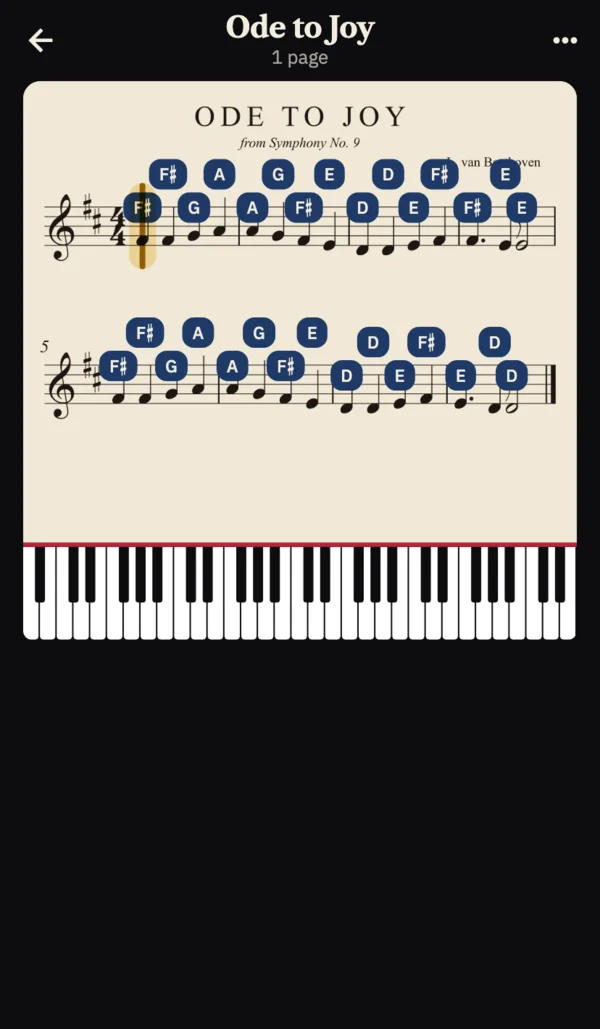
Name the notes in a piece you're learning. A note reader app like Sheet Music shows the letter of every note on a page you scan, so you can check yourself as it plays.
Learning to read music? See every note named
Sheet Music reads a printed page with your phone camera, shows the letter of every note, and plays it back with a cursor moving along your own page. Free for iPhone and Android.


Questions
What are the notes of the treble clef?
The five lines, from the bottom up, are E, G, B, D and F: Every Good Boy Does Fine. The four spaces spell FACE. Below the staff come D in the space and middle C on the first ledger line; above it, G in the space and A on the first ledger line.
What are the notes of the bass clef?
The five lines, from the bottom up, are G, B, D, F and A: Good Boys Do Fine Always. The four spaces are A, C, E and G: All Cows Eat Grass. Middle C sits on the first ledger line above the staff, and E on the first ledger line below it.
Where is middle C on the staff?
On the first ledger line below the treble staff, and on the first ledger line above the bass staff. Both are the same note: the C closest to the middle of a piano keyboard, also called C4.
Why is the treble clef called the G clef?
Its curl wraps around the second line of the staff, which marks the G above middle C. The bass clef is the F clef: its two dots sit on either side of the fourth line, the F below middle C.
What is the fastest way to learn the notes?
Learn a few landmark notes first, like middle C, treble G and bass F, and read the others as steps up or down from them. Then practice for a few minutes a day with a note quiz and read real music, so the names stick in context.