No symbol matches that. Try another word, like rest, loud or repeat.
Staff and clefs
Where the notes go, and which notes the lines stand for. More on reading them in treble and bass clef notes.
Staff
Five lines and four spaces. Each line and space is a different note, and higher up the staff means higher in pitch.
Treble clef
Also called the G clef. Its curl circles the second line, the G above middle C. Used for higher notes.
Bass clef
Also called the F clef. Its two dots sit either side of the fourth line, the F below middle C. Used for lower notes.
Alto clef
A C clef. Its middle points at middle C on the middle line. Used mostly for viola.
Ledger lines
Short lines above or below the staff, for notes too high or too low to fit on it.
Grand staff
A treble and a bass staff joined by a brace. Piano music uses it: right hand on top, left hand below.
Bar line
Splits the music into bars, also called measures, each with the same number of beats.
Double bar line
Marks the end of a section, or a change such as a new key or time signature.
Final bar line
A thin line and a thick line mark the end of the piece.
Notes and rests
How long each sound or silence lasts. The beats here are for 4/4, where a quarter note gets one beat.
Whole note
Lasts four beats. An open note head with no stem.
Half note
Lasts two beats. An open note head with a stem.
Quarter note
Lasts one beat. A filled note head with a stem.
Eighth note
Lasts half a beat, so two make one beat. It has one flag.
Sixteenth note
Lasts a quarter of a beat, so four make one beat. It has two flags.
Beamed notes
Eighth notes, or shorter, joined by a beam instead of flags, grouped by the beat.
Dotted note
A dot adds half the note's value: a dotted half note lasts three beats, a dotted quarter one and a half.
Tie
Joins two notes of the same pitch. Play the first one and hold it for both values.
Triplet
Three notes played in the time of two of the same kind, marked with a 3.
Whole rest
Silence for a whole bar, four beats in 4/4. It hangs from the fourth line.
Half rest
Silence for two beats. It sits on the middle line.
Quarter rest
Silence for one beat.
Eighth rest
Silence for half a beat.
Sixteenth rest
Silence for a quarter of a beat.
Sharps, flats and naturals
Signs that move a note up or down. One in front of a note lasts until the end of the bar.
Sharp
Raises a note by a half step, to the very next key on the right.
Flat
Lowers a note by a half step, to the very next key on the left.
Natural
Cancels a sharp or flat, back to the plain note.
Double sharp
Raises a note by two half steps, a whole step.
Double flat
Lowers a note by two half steps, a whole step.
Time, key and tempo
The signs at the start of the music that set the beat, the key and the speed. More in how to read sheet music.
Time signature
The top number is how many beats are in each bar. The bottom number is which note gets one beat: 4 for a quarter note.
Common time
Another way to write 4/4: four quarter-note beats in a bar.
Cut time
Also called alla breve: 2/2, two half-note beats in a bar.
Key signature
Sharps or flats after the clef that apply to those notes all through the piece. Two sharps, F and C, is D major or B minor.
Metronome mark
The exact speed. Here, 120 quarter-note beats per minute.
Tempo marking
A word for the speed, often Italian: Adagio is slow, Andante a walking pace, Allegro fast.
Dynamics
How loud or soft to play. The letters come from Italian: p for piano, soft, and f for forte, loud.
Pianissimo
pp: very soft.
Piano
p: soft.
Mezzo-piano
mp: moderately soft.
Mezzo-forte
mf: moderately loud.
Forte
f: loud.
Fortissimo
ff: very loud.
Sforzando
sfz: a sudden, strong accent on one note or chord.
Crescendo
Get gradually louder. Also written cresc.
Decrescendo
Get gradually softer. Also written decresc., or dim. for diminuendo.
Articulation and ornaments
How to play each note: short, stressed, held or decorated.
Staccato
Play the note short and detached.
Accent
Play the note with a stronger attack than the notes around it.
Tenuto
Hold the note for its full value, often with a little weight.
Marcato
A strong accent, more forceful than a regular accent.
Slur
A curve over notes of different pitch. Play them smoothly, connected, without a break.
Fermata
Hold the note or rest longer than its value, as long as feels right or the conductor shows.
Trill
Alternate quickly between the note and the note above it.
Turn
Play the note above, the note, the note below, then the note again.
Breath mark
A short break to take a breath, or a small gap in the sound.
Repeats and jumps
Signs that send you back or ahead in the music. Find them all before you start playing.
Repeat signs
Play the music between the two signs twice. With no start sign, go back to the beginning.
First and second endings
Play the first ending, repeat, then skip it and play the second ending.
Da capo
D.C.: go back to the beginning. D.C. al Fine: play from the beginning to the word Fine and stop.
Dal segno
D.S.: go back to the segno sign. D.S. al Coda: play to To Coda, then jump to the coda.
Segno
The sign that D.S. sends you back to.
Coda
Marks the ending section. At To Coda, jump straight to this sign.
Fine
Italian for end. Where the music stops after D.C. al Fine or D.S. al Fine.
Octaves and pedals
Signs for playing higher or lower than written, and for the piano pedal.
Ottava
Play the notes under the dashed line an octave higher than written.
Ottava bassa
Play the notes over the dashed line an octave lower than written.
Sustain pedal
Press the right pedal at Ped. and let it up at the star, so the notes keep ringing.
Reading a page full of symbols
Check the top first
Before you play, read the clef, key signature, time signature and tempo. They hold for the whole piece until something changes them.
Map the jumps
Find every repeat sign, ending, D.C., D.S. and coda, and trace the order you'll play the sections in before you start.
Hear it as you read
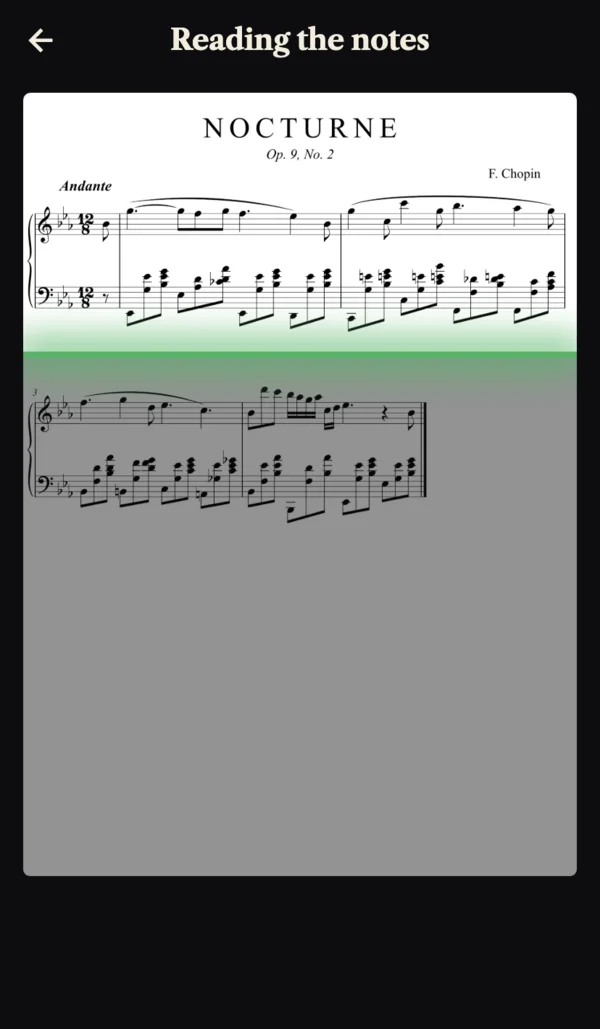
The signs make more sense while the music plays. A player app like Sheet Music reads a printed page from a photo and plays the notes back with a cursor on the page.
Not sure how it goes? Scan it and hear it
Sheet Music reads a printed page with your phone camera and plays the notes back, with a cursor moving along your own page. Slow it down while you learn. Free for iPhone and Android.


Questions
What are the basic music symbols?
The staff and the clef, notes and rests for the pitch and length of each sound, sharps and flats, the time signature, and dynamics like p and f for soft and loud. Most beginner music uses only these.
What does the bird's eye symbol mean in music?
That is a fermata: a curve with a dot under it. Hold the note or rest longer than written, for as long as feels right or the conductor shows.
What do p and f mean in music?
They are dynamics, from Italian. p is piano, soft, and f is forte, loud. pp and ff mean very soft and very loud, and mp and mf are in between.
What is the difference between a tie and a slur?
A tie joins two notes of the same pitch, and you play them as one long note. A slur covers notes of different pitches, and you play them smoothly, without a break.
What does D.C. al Fine mean?
Da capo al Fine: go back to the beginning and play again until the word Fine, then stop.