1
Learn the staff
Music is written on a staff of five lines and four spaces, counted from the bottom up. A note higher on the staff sounds higher. Bar lines split the music into bars, also called measures, so you can keep your place.
Seven short steps, from the five lines of the staff to the speed and loudness of a piece. Each one has a picture, and at the end you read a real melody and hear it play as you follow along.
1
Music is written on a staff of five lines and four spaces, counted from the bottom up. A note higher on the staff sounds higher. Bar lines split the music into bars, also called measures, so you can keep your place.
2
The symbol at the start of each line tells you which notes the lines stand for. The treble clef is for higher notes, like the right hand on piano. The bass clef is for lower notes, like the left hand. Piano music uses both at once.
Every note of both clefs, on a chart you can tap and hear: treble and bass clef notes.
3
Notes use the letters A to G, then start again. In the treble clef the lines are E G B D F (Every Good Boy Does Fine) and the spaces spell FACE. In the bass clef the lines are G B D F A (Good Boys Do Fine Always) and the spaces A C E G (All Cows Eat Grass).
4
A note's shape tells you how long it lasts. In 4/4 a whole note gets four beats, a half note two, a quarter note one, and an eighth note half a beat. Each note has a rest of the same length, a moment of silence. A dot after a note adds half its value again.
| Note | Name | Beats in 4/4 | Rest | Rest note |
|---|---|---|---|---|
| 𝅝 | Whole note | 4 | 𝄻 | Hangs from the fourth line |
| 𝅗𝅥 | Half note | 2 | 𝄼 | Sits on the middle line |
| 𝅘𝅥 | Quarter note | 1 | 𝄽 | |
| 𝅘𝅥𝅮 | Eighth note | ½ | 𝄾 | |
| 𝅘𝅥𝅯 | Sixteenth note | ¼ | 𝄿 |
Two notes joined by a curved line, a tie, are held as one long note: a half note tied to a quarter note lasts three beats.
5
The two numbers after the clef are the time signature. The top number is how many beats are in each bar. The bottom number is which note gets one beat: 4 means a quarter note, 8 an eighth note.
6
Sharps or flats right after the clef are the key signature. They apply to that note everywhere in the piece, in every octave. A sharp, flat or natural written in front of a single note lasts only until the next bar line.
One sharp, F sharp, is the key of G major or E minor. One flat, B flat, is F major or D minor. No sharps or flats is C major or A minor.
7
A word above the first bar sets the speed, often in Italian: Andante is a walking pace, Allegro is fast. Letters under the notes set the loudness, from pp, very soft, to ff, very loud.
| Marking | Meaning | Beats per minute |
|---|---|---|
| Largo | Very slow and broad | 40–60 |
| Adagio | Slow | 66–76 |
| Andante | At a walking pace | 76–108 |
| Moderato | Moderate | 108–120 |
| Allegro | Fast and bright | 120–156 |
| Presto | Very fast | 168–200 |
| Sign | Italian | Meaning |
|---|---|---|
| pp | pianissimo | Very soft |
| p | piano | Soft |
| mp | mezzo-piano | Moderately soft |
| mf | mezzo-forte | Moderately loud |
| f | forte | Loud |
| ff | fortissimo | Very loud |
Speeds are a guide, not a rule. Many pieces also give an exact speed as a number of beats per minute.
The opening of Ode to Joy by Beethoven, in 4/4. Read the letters and count the beats, then press Play and follow the cursor.
Swipe for more bars →
To hear a piece of your own played this way, a player app like Sheet Music reads a printed page from a photo and plays it back with a cursor on your own page.
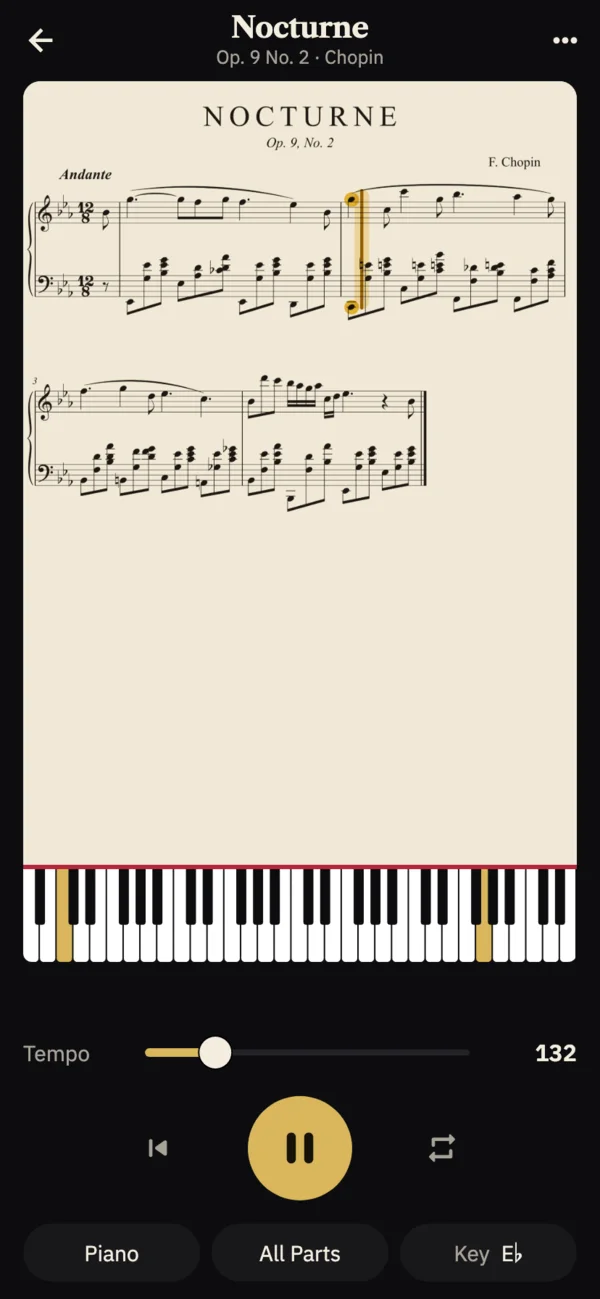
Sheet Music reads a printed page with your phone camera and plays it back, with a cursor moving along your own page and every note named if you like. Slow it down while you learn. Free for iPhone and Android.


It depends on how often you practice. With a few minutes a day, most beginners can read a simple melody within a few weeks. Reading quickly at sight takes longer, and comes from reading a little new music every day.
That is the time signature. The top number is how many beats are in each bar, and the bottom number is which note gets one beat. In 4/4 there are four quarter-note beats in every bar; in 3/4 there are three.
Yes. Bar is the usual word in British English and measure in American English. Both mean the stretch of music between two bar lines.
A dot adds half of the note's value. A dotted half note lasts three beats instead of two, and a dotted quarter note lasts one and a half beats.
Yes. Learn the staff, the clefs and the note values, practice naming notes for a few minutes a day, and read short, simple pieces. Hearing a piece played while you follow the page helps you check that you read it right.